


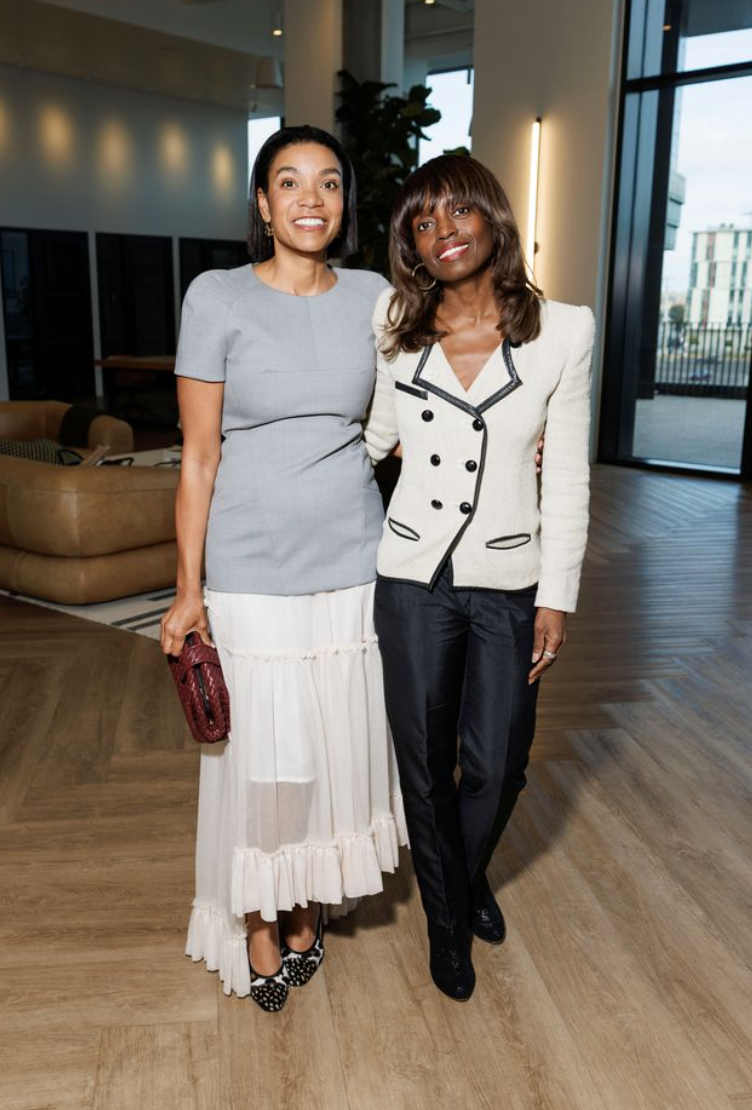
On a foggy evening at Mission Rock overlooking the San Francisco waterfront, founders, investors, and senior executives gathered for The WIE Suite's Women in Leadership Dinner in partnership with Studio by Tishman Speyer. The evening's conversation featured Leah Solivan, founder of TaskRabbit and General Partner at Fuel Capital, in discussion with The WIE Suite Founder and CEO Dee Poku on a topic that resonated deeply with the women around the table: what it takes to build, and lead, through scale.
While much of the startup ecosystem celebrates speed, disruption, and growth at all costs, Solivan offered a different perspective. Reflecting on her journey from engineer to founder to investor, she spoke candidly about the less glamorous realities of leadership: navigating uncertainty, making unpopular decisions, and learning where your strengths end and someone else's should begin. Guests at the table included: Tracy Sun, Co-founder of Poshmark, Osi Imeokparia, CEO at Kode with Klossy, Heidi Zak, Co-founder & CEO at Thirdlove, among other female founders and executives.
One of the evening's most memorable moments came when Solivan reflected on her early years as CEO.
"I was the worst at managing people," she said, prompting laughter around the table. "That is why I will never start another company again."
The remark was characteristically direct, but it underscored a larger point about leadership. As companies grow, founders are often forced to confront an uncomfortable truth: the skills that help build a business are not always the same ones required to scale it.
For Solivan, that realization led to one of the most important decisions of her career: hiring Stacey Brown-Philpot as COO. Together, the pair built the operational infrastructure that helped TaskRabbit expand internationally and ultimately positioned the company for its acquisition by IKEA.
"I've always been able to recognize areas where I'm not as strong and where other people are stronger," Solivan said. "I was willing to relinquish power in areas I wasn't as confident about."

The conversation repeatedly returned to the theme of founder judgment - a quality Solivan now evaluates from the other side of the table as an investor. Throughout TaskRabbit's growth, she often found herself balancing external advice against her own understanding of the business.
One example was the decision to expand into London, despite skepticism from investors who favored a more conventional U.S. growth strategy.
"We knew the growth numbers were not going to come from Cincinnati," Solivan said with a smile. Instead, she and her team focused on what the data suggested rather than what conventional wisdom prescribed.
That decision would ultimately prove pivotal. London became one of TaskRabbit's strongest markets and led to the partnership with IKEA that evolved into an acquisition.
For Poku, the story illustrated a broader leadership challenge many women face: learning when to seek guidance and when to trust their own instincts.
The discussion also explored the realities of organizational change. As TaskRabbit evolved from an early marketplace model into a mobile-first platform, the company faced resistance from customers, employees, and industry observers alike.
"People don't like change," Solivan noted. "But scale requires change."
The lesson resonated with a room full of leaders navigating transformations of their own - whether inside growing companies, investment firms, or established organizations adapting to new market realities.
As the conversation opened to attendees, the discussion shifted toward the complexities of hiring senior leadership, building trusted partnerships, and creating teams capable of sustaining growth beyond a founder's individual capacity. Solivan spoke candidly about the value of executive coaching, leadership assessments, and cultivating greater self-awareness as organizations become more complex.
The founders who succeed, Solivan argued, are not necessarily the smartest people in the room. They are the ones driven by something deeper than external validation.
At Fuel Capital, where she now backs the next generation of entrepreneurs, that remains one of the first things she looks for.
"I'm looking for founder-market fit," she said. "Why is this person building this particular business?"
It was a fitting note on which to end the evening. In a room filled with women building companies, leading teams, and shaping industries, the conversation served as a reminder that enduring success rarely comes from following someone else's playbook. More often, it comes from developing the conviction to trust your own.
Special thanks to Studio by Tishman Speyer for hosting the evening at Mission Rock and for their partnership in fostering thoughtful conversations among the women shaping the future of business, culture, and leadership.
